In my previous blog post, I covered some of the reasons why a child might be underweight, with a particular focus on slowed growth in infants. Today I will discuss slow growth in toddlers and preschoolers / underweight toddlers and preschoolers.
It is not uncommon for parents to share stories about how well their babies accepted milk, bottles, and even solids during infancy. However, something seems to change during toddlerhood—the baby who once loved food suddenly refuses to eat. There are several reasons behind this:
- After 12 months of age, a child’s rate of growth naturally start to slow down.
- Neophobia, a fear of new foods will typically emerge around this age. This is an interesting article that talks about neophobia in children
- A child’s growing desire for independence means that saying “no” can feel very powerful for a little child.
When should parents worry about their child’s poor growth?
Fussy eating is normal and expected in toddlers and preschoolers. If a child is selective with food but still consumes a reasonable variety across all food groups and continues to follow their growth curve, there is usually no major concern and I will encourage parents to continue to offer a variety of food to the child. However, health professionals including doctors, child health nurses, and paediatric dietitians will become concerned when a child’s weight percentile starts to drop significantly.
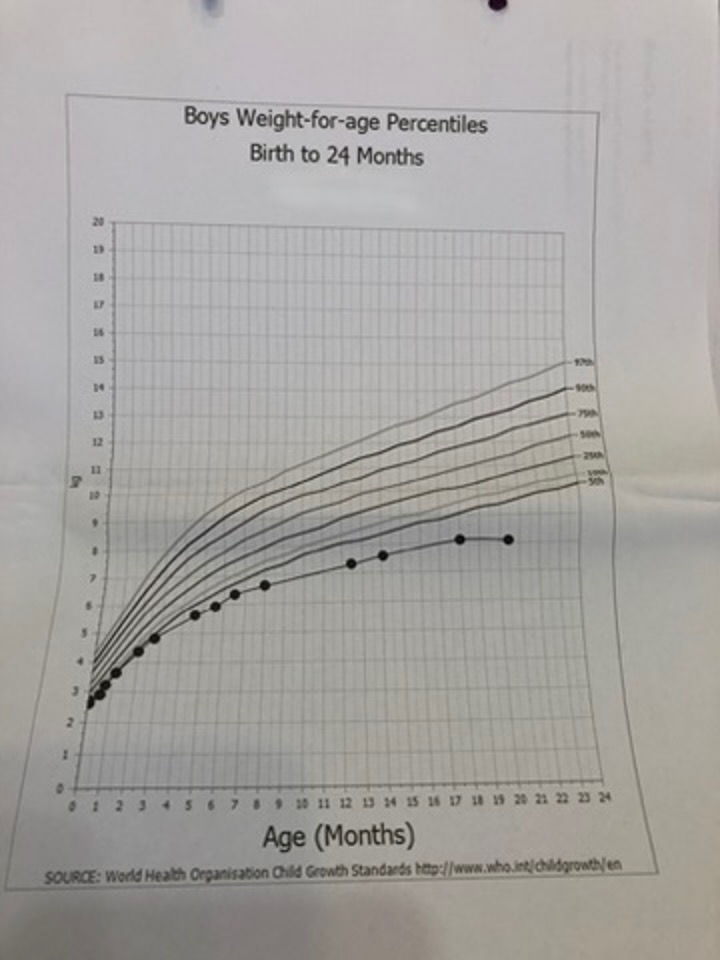
This growth chart above is an example of a 20-month-old boy who was referred to me for management of poor growth. As seen on the chart, he had always been small but was tracking along the 5th percentile for the first few months of his life. However, his weight then started to fall away from the 5th percentile when he was just under six months of age and his weight tracked just under the 5th percentile. At his one-year health check, the paediatrician noticed a gradual decline in weight percentile, and after no weight gain over two months, referred him to me for nutrition optimisation. Although he continued to gain weight, he was not keeping pace with expected growth, leading to faltering growth.
How toddlers and preschoolers differ from Infants?
It is important to note that toddlers and preschoolers have a slower growth rate compared to infants. Unlike infants who may still rely on milk or be newly introduced to solids, toddlers and preschoolers are expected to be well-established on solid foods. They are also more capable of expressing food preferences and asserting independence at mealtimes including wanting to have a say around what to eat at meals or snack times. Preschoolers may insist on greater control over what they eat and how much. Both toddlers and preschoolers by now will have very clear feeding cues on when they do not want food, and they will demonstrate this by:
- Pushing food away
- Refusing to eat the offered food
- Spitting food out
- Holding food in their mouth without swallowing
- Throwing food
- Refusing to come to the table or highchair for meals
What to do with toddlers and preschoolers with poor growth
My number one recommendation is do not force feed them. Force-feeding is not only ineffective in helping a child with growth, but it will also create negative mealtime experiences, harming the parent-child feeding relationship. Similar to infants, a child who fails to gain adequate weight for an extended period of time can also experience slowed growth in terms of height.
If a toddler or preschooler who was previously tracking well on their growth chart suddenly experiences minimal or no weight gain, they should see a GP or paediatrician to rule out medical conditions that can lead to poor growth. Certain medical issues such as coeliac disease can impair nutrient absorption, so even though a child is eating well, their body may not be absorbing nutrients, leading to poor growth. Addressing any underlying medical issues is essential before focusing on nutritional intake. Nutrient deficiencies should also be addressed and treated with supplementation.
If no medical causes are found, poor intake is likely the cause of slow growth. A paediatric dietitian can work with families, doctors, and other health professionals to provide a comprehensive feeding plan, including:
- A detailed assessment of the child’s food and drink intake
- Any feeding related issues such as food refusal
- Concerns around malabsorption or vomiting
- Mealtime structure and family feeding environment
- Previously attempted interventions to help with poor growth
Sensory aversion
Children with sensory aversions can be exceptionally difficult to manage without the right support. These children often refuse a big range of foods, including refusing entire food groups (such as refusing all vegetables or all meats) or refuse entire food texture (such as refusing any food with lumps but not puree or finger foods). Children with suspected sensory aversion should be referred to specialised feeding therapist, typically an occupational therapist or speech pathologist, and sometimes a dietitian.
Inefficient oral-motor skills
Some children who thrived as an infant may develop poor growth when families transition from cut up or pureed foods to family table foods. These children previously eat well because food are cut up into extremely small pieces, and there is little need to learn to chew food. When a child turns 12 months of age, most families start to move away from preparing separate food for infants, to offering same food as the family, which is the usual recommendation for toddlers. If they have not learned to chew effectively, they may struggle with family meals, leading to a preference for commercial baby foods over home-made meals and an overreliance on milk. Over a period of time, the combination of high milk intake together with low food intake can lead to poor growth and nutrient deficiencies. It is very common for children to make up for lack of solid food intake with excessive milk intake, contributing to iron deficiency anaemia. This can cause children to feel tired or fatigue easily further reducing appetite as mentioned by this study and exacerbating poor growth.
How to help toddler or preschooler who is underweight?
There is no one size fit all approach in managing children with poor growth. It is essential to work with a paediatric Dietitian to develop a personalised plan that works for your family. Here are six strategies that might help:
- Create a Positive Mealtime Environment – Never force feed as this will not work in the long run. The Ellyn Satter Division of Responsibility approach can reduce mealtime stress, where parents decide what, when, and where food is offered, while the child decides how much to eat (or whether to eat at all).
- Make Every Bite Count – Ensure every mouthful is high in energy, protein, or nutrients to support growth.
- Offer Small Portions – Large portions can be overwhelming. Start with small amounts and offer more when your child finish what they have on their plate.
- Set Realistic Expectations – If serving a meal your child is unlikely to eat, include at least one familiar and accepted food to prevent complete meal rejection. This breaks the cycle of a child refusing a meal, knowing that you will make a new meal for them.
- Provide Regular Meals and Snacks – Offer three main meals and 2–3 snacks daily as children has smaller appetite. This will provide consistent energy intake, especially if your child does not eat well at main meals.
- Limit Milk Intake – Keep milk consumption to no more than 500ml per day to encourage appetite for food intake
If you have older children, stay tuned for my third and final part of this series on underweight children / children with poor growth.
