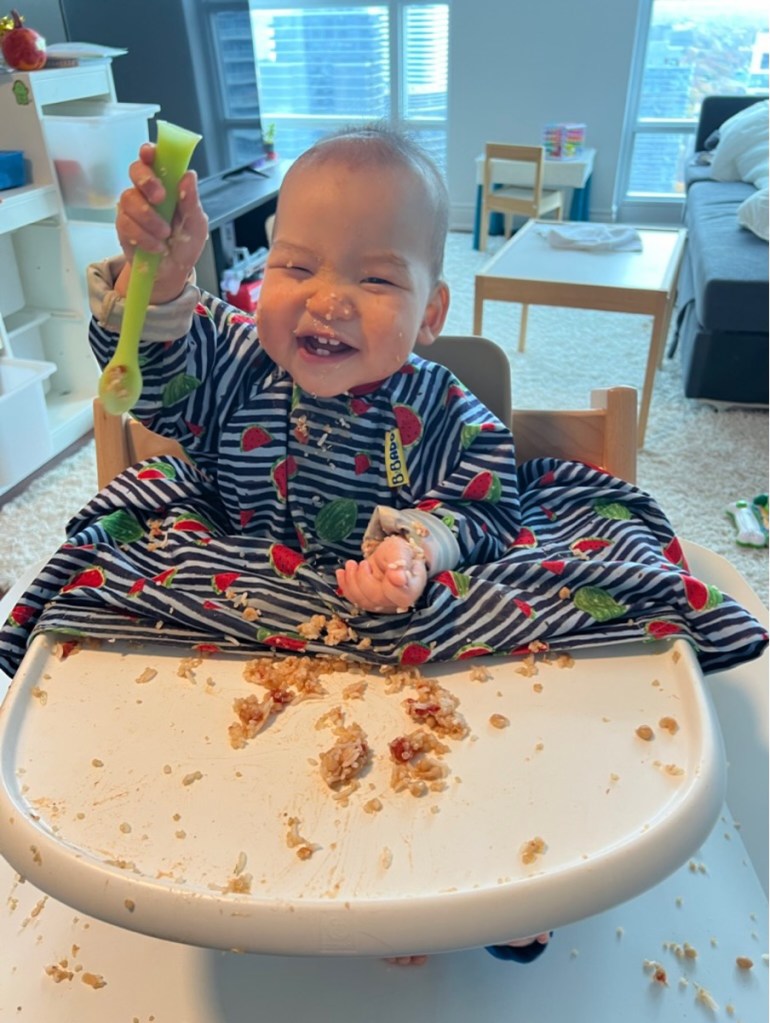
Messy eating is a normal and expected part of a baby’s mealtime. But what’s the deal with mess, and what should you know about it? Read on to discover the benefits of messy eating, especially for infants who are just starting out on solids.
Why Messy Eating Matters
Infants rely on breastmilk or formula for at least the first four to six months of their life, depending on advice from your healthcare professional and whether your baby is showing signs of readiness to start solids. When introducing solids, there are a two common approaches: the conventional spoon feeding by carers or parent using a spoon, starting with purées, then progressing to lumpy foods and then to finger foods; and then there is the baby-led weaning (BLW). I personally use a mixture of both methods, and while some people claim BLW is superior, I don’t believe that’s necessarily true and there is benefit in both methods of introducing solids. Let’s take a closer look at how messy you can expect your baby to be!

Parental Expectations vs Baby’s Experience
Parents often expect their baby to eagerly open their mouth for new foods. While this may be true for some babies, others may react differently. It can be disheartening to see your baby scrunch up their face at a lovingly prepared meal, but this is completely normal. Imagine only ever having liquid and then suddenly experiencing solid food—it’s a strange new sensation! Babies explore food using all their senses. It looks different, smells different, feels different, tastes new, and even varies in temperature throughout the meal. Some babies may be overwhelmed, while others are curious and embrace the experience and may even want more.
Since babies have never encountered solids before, they use all their senses to explore. While we, as adults, instantly recognise food on a plate, babies don’t. To them, it could be a toy, an object to wear, or something to squish. First, they look at it. If they’ve seen you eat it before, they might recognise it as food, something we put in our mouths. Next, they touch it, discovering its texture—is it soft, firm, warm, or cold? Does it slip through their fingers like water, or stay firm like a cracker? This curiosity leads them to squish, poke, shake, or even throw food to see what happens. It’s all part of the learning process. And yes, that means the learning process is messy.
Some babies put food straight into their mouth, while others hesitate. Many will look to their parents or caregivers for reassurance. It’s important to be encouraging—if you smile and show enjoyment, they’re more likely to explore. However, if you frown or express frustration when a baby is making mess while exploring, they may associate your facial expression with the food being “wrong” and be reluctant to try it. Some babies struggle with coordination and might miss their mouth, accidentally smearing food on their face or head. Others might be sensitive to strong smells, such as fish or eggs, and need more time to adjust.
It is not surprising that babies who are spoon fed may appear to make less mess compared to BLW. This is because babies who are spoon fed may not have the opportunity to reach out and explore food. Whilst this may sound great for some families, limiting your babies opportunity to explore food can cause your baby to be more hesitant to try new foods. This is because babies need to use all of their senses to learn about any new experience, and this includes eating.
Why Spitting Out Food Is Normal?
Some babies put food in their mouth and immediately spit it out—not necessarily because they dislike it, but because it’s unfamiliar. It is usually the texture or taste that your baby is learning about. Spitting food out is a normal part of learning and should not be mistaken for rejection. And whilst it is frustrating to see food end up on their outfit, a baby need repeated exposure to textures helps prevent fussy eating later in life.
Some babies prefer their food separate rather than mixed, which is completely fine. If your baby enjoys plain pasta over pasta with sauce, continue to serve pasta with sauce together rather than always offering them plain pasta. This helps them become familiar with the combined texture and flavour over time.
So in summary, babies explore food using all their senses and their reaction can vary widely. Babies will typically explore food by looking at them first, touching the food and experimenting what is offered to them, before they decide to taste them. And whenever they are ready, they will swallow the food (or spit them out to signal they need more time to explore this new food).
How About Older Children?
Messy eating is common in toddlers too! Before children develop table manners, they must first learn how to eat efficiently. I often hear parents (including my husband!) complain about messy eating, but it’s important to remember that children learn best through play. If a toddler picks up a piece of spaghetti and excitedly says, “Mummy, look! I found a snake!”—how we respond matters. If we nag them for playing with their food, mealtimes may become boring or stressful. However, if we engage with their imagination in a positive way, they may happily continue eating while having fun, making meal times are less stressful for the parent and the child.
Setting Boundaries That You Are Comfortable
Learning about food and encouraging positive meal times does not mean allowing food to be thrown across the room either! Setting boundaries is important, and you as a parent need to decide what boundaries is important for you. For example:
- Instead of saying, “Stop making a mess!” try, “I see you’re having fun, but let’s keep the food on your plate.” This keeps the mess in a smaller area which makes cleaning manageable while allowing your child to explore their food.
- Accidental messes, like spilled drinks or knocked-over bowls, are expected as children develop fine motor skills. Just as we wouldn’t scold a child for tripping while learning to walk, we should be patient as they learn to eat. It can be frustrating, but remember to take deep breaths, your child is learning and they need our patience to help them.
- Use spills as a learning opportunity by asking, “What can we do about this mess?” For younger children who need more guidance, you might say, “Oops! That’s a big mess. Let me help you to clean this up together.” This teaches your child valuable problem solving skills and how to correct their mistakes (spills) or to clean up after themselves, while allowing them to explore food freely.
At the end of the day, messy eating is normal and plays a crucial role in a child’s development. It helps babies and children explore different properties of food, build familiarity, and even develop essential life skills—such as problem-solving skills where they learn it is okay to make a mess because they will clean up after themselves., More importantly, how we respond to babies and children with messy eating makes all the difference. Setting gentle boundaries, role-modelling appropriate eating habits, and encouraging exploration all help children develop positive relationships with food. With time, patience, and plenty of practice, messy eating will become a distant memory. While it’s not always easy, children will eventually learn to eat more efficiently and with less mess. As children grow, they will also be able to understand and follow simple instructions, allowing families to find solutions that work for them. With encouragement, patience, and consistency, mealtimes can be an enjoyable and positive experience for the whole family.